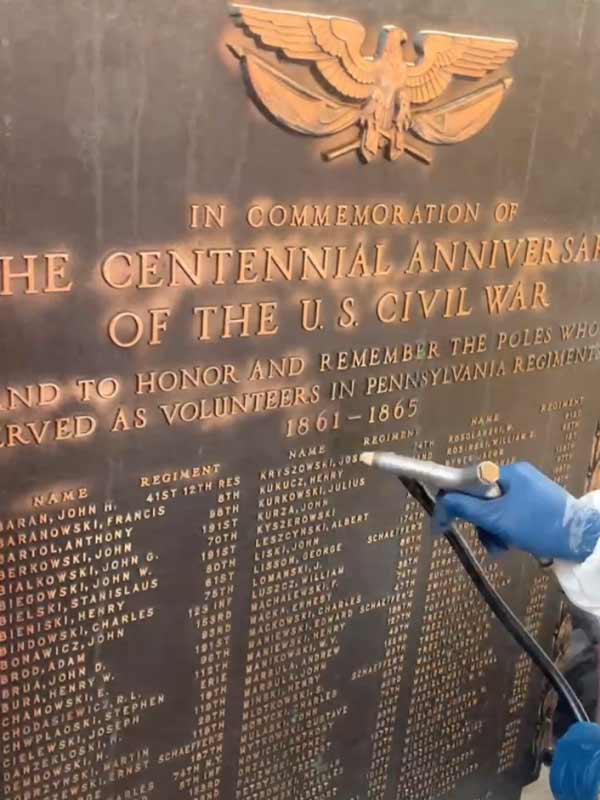
The bronze plaques in the images were installed in the outside portico of Pittsburgh’s City-County Building. The images show an honor roll style monument in memory of the Polish citizens who served as volunteers in Pennsylvania Regiments during the Civil War 1861-1865. It was installed September 26, 1964, sponsored by the Central Council of Polish Organizations. Also refinished was a plaque engraved with the Gettysburg Address. The plaque was dedicated by the National Woman’s Relief Corps, a fraternal organization of veteran’s families, in memory of the Grand Army of the Republic. This memorial holds the text of the Gettysburg Address, delivered by President Abraham Lincoln at the dedication of the Soldiers’ National Cemetery on November 19, 1863. Lincoln’s iconic, 271-word address has come to be considered one of the most important and influential speeches in the history of the United States.
Fine Art Architectural went down to the City County Building and unbolted the degraded plaques from the wall. While the Gettysburg address plaque was cumbersome at approximately fifty pounds, the Civil War Memorial plaque weighed approximately 250 pounds. The Gettysburg plaque was extremely degraded: the lower half of the highlighted raised lettering was darkened nearly to black. Only a patchy remnant of the original raw bronze remained. The plaque was bolted to the stone wall with zinc coated steel lag screws set into lead plugs. Bronze rosette bolthead covers secure to the hex head screws with a small set screw. Two of the rosette bolt covers were lost. The Civil War plaque for Polish Veterans was badly blanched and covered with vertical dark rivulets. Much of the polished lettering and relief decoration was still intact, but it was showing the beginnings of darkening and oxidation. The original brown background had faded to a dark greenish black.
The plaques were loaded into a van and transported back to our workspace in West Homestead, PA. The plaques were washed with soapy water and rinsed with fresh water. The raised lettering, relief decoration and raised polished frames were brightened by peening with glass beads through an air abrasion tool. The backgrounds of both plaques were also pared down through light air peening. Once brightened, the brightened areas were further finished with directional abrasion with 220 grit sandpaper.
The surfaces of the plaques were degreased by wiping with solvent on cotton cloths and were then given three spray coats of brown tinted synthetic lacquer. This step may seem odd, because it covers the brightened areas with a semi-opaque coat of brown lacquer. But then the lacquer is cleared from the raised surfaces by using a solvent moistened block covered with cotton jersey. The block is run over the high points of the brightened areas, bridging it between words and numbers on nearby lines of text. The solvent-moistened block clears the lacquer and reveals a bright, raw bronze surface. Removal of tinted lacquer from relief decoration needs to be artfully done, subtracting patina until the motif is in crisp contrast to the background. Three coats of clear synthetic lacquer were spray applied overall to seal the surface.
Fine Art Architectural Restoration Services uses a next-gen synthetic lacquer for refinishing, that is engineered to resist changing appearance. The coating remains soluble in commonly used restoration solvents for decades and can usually be fixed locally and without needing to strip the entire object.
Two replacement rosette bolthead covers were fabricated by making silicon rubber molds of the existing bolt covers. The molds were then cast with epoxy gel tinted with colorants to look like patinated bronze. The relief decoration on the rosettes were given a swipe with gold toned lacquer to further blend them.
Fine Art Architectural Restoration Services then carefully loaded the refinished plaques into a van and delivered them to the portico of the City County Building. Working under the gaze of the public and City County employees, including the mayor Ed Gainey, four handlers installed both plaques on-site and bolted them into their original locations with their original hardware. Our extensive experience in museums enable us to work safely in high-profile, highly visible locations, often with power tools and chemicals.
In 1911, a City of Pittsburgh Commission was formed by unanimous resolution of the City Council for the construction of a new City Hall. The Commission employed New York architect Cass Gilbert to arrange a competition for the design of a new municipal building. Of the 16 entries, the winning design was submitted by the firm Palmer, Hornbostel, & Jones of New York. The building acted as a gift to Pittsburgh to honor the 1916 Centennial of Pittsburgh's 1816 incorporation as a city. At the March 1916 dedication ceremony, Mayor Joseph Armstrong placed a time capsule into the still under construction building. Two and a half years later in December 1917, he would become the first Mayor to call the City-County Building a second home. The missing time capsule has yet to be discovered.