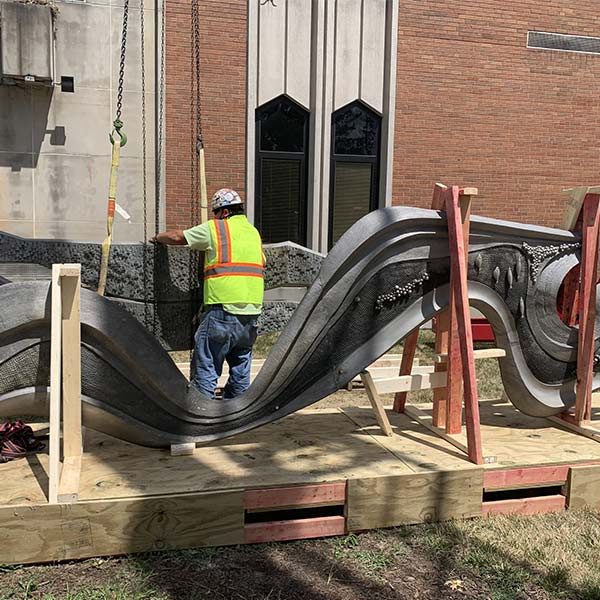
Deinstalling and Moving the Monumental Tree of Education Sculpture (1967) from the Former Berea Highschool in the Cleveland Suburbs.
The Aluminum Tree of Education was commissioned by the Berea School District in 1967 by Robert Filious, a local artist and graduate of the Cleveland Institute of Art and classmate of celebrated designer Viktor Schreckengost. The mixed-media, multi-part sculpture consists of an 18’ foot tall cast-aluminum, stylized tree trunk resembling an undulating flame with two smaller, wall-mounted aluminum plaque-like elements. The sculpture features a smaller seven-branched tree depicting different areas of education: History, Science, Geography, Physical Education, Arts, Economics, and Literature & Humanities. At the top is a relief map of Berea overlaying an abstract representation of Rocky River and Lake Erie. On a separate smaller plaque in the upper right is a map of Cleveland Hopkins International Airport; in the upper left is a plaque with a rocket superimposed on the buildings of NASA. The intriguing artwork met with a mixed reaction after it was installed. The cost of the sculpture could have funded a teacher’s salary at the time for a year.
In 2013, the Berea and Midpark school districts consolidated due to declining enrollment, and in 2017 they were in the process of designing and building the new Berea-Midpark High School in Berea. The old Berea High School was scheduled to be demolished, and initially, no plans were submitted for salvaging the sculpture.
The sculpture was close to being lost forever until the Berea High School Alumni Association stepped in to save the sculpture. They approached professionally trained preservation contractors around the region to assist with the task of carefully removing the multi-part sculpture from the façade of the building. Although no new location was determined for the sculpture, it was decided that it would be removed from the façade by crane, then palletized and wrapped for transport. The sculptural elements, including the 18’ tall cast-aluminum tree trunk, would be transported to a nearby school storage facility for long-term storage until a decision for future display was to be made.
A Cleveland-area rigger with experience moving high-profile public artworks was hired as the general contractor for dismantling the artwork. Fine Architectural Restoration staff oversaw the complicated deinstallation and transport, and also provided a treatment plan for complete restoration.
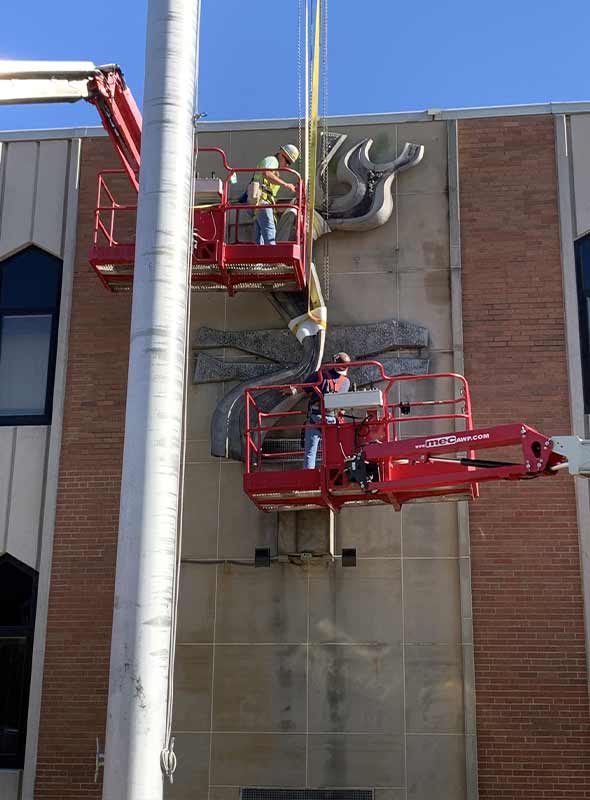
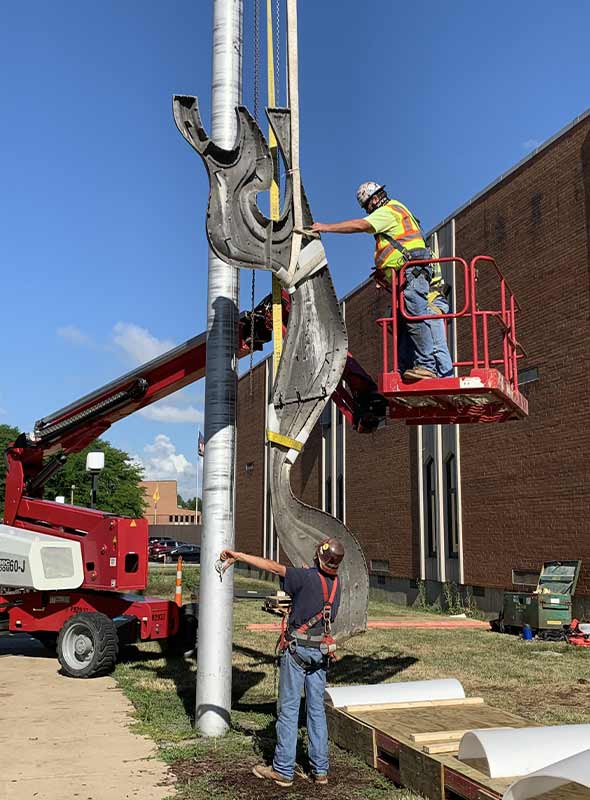
Riding up in an articulating lift basket with the riggers, the integral aluminum stand-offs were carefully cut one by one with a reciprocating saw. The sculptural elements required individual slinging and partial support by crane to preclude swinging and shifting as the stand-offs were cut. Being some 25 feet up close to the sculpture enabled close examination of how the parts of the sculpture fit together, and also revealed the areas where organic debris has a tendency of accumulating.
Once each element was free from the façade, it was lowered to the ground onto a custom-made palette, designed by Fine Art Architectural staff. The massive tree-trunk element was the most cumbersome, but by far the most fragile element was the smaller seven-branched tree element with painted metal and fiberglass eyes, each containing a different discipline of education: History, Science, Geography, Physical Education, Arts, Economics, and Literature & Humanities. The fiberglass eyes were degraded and cracking, each one held in place to the smaller tree with a single zinc-coated steel screw.
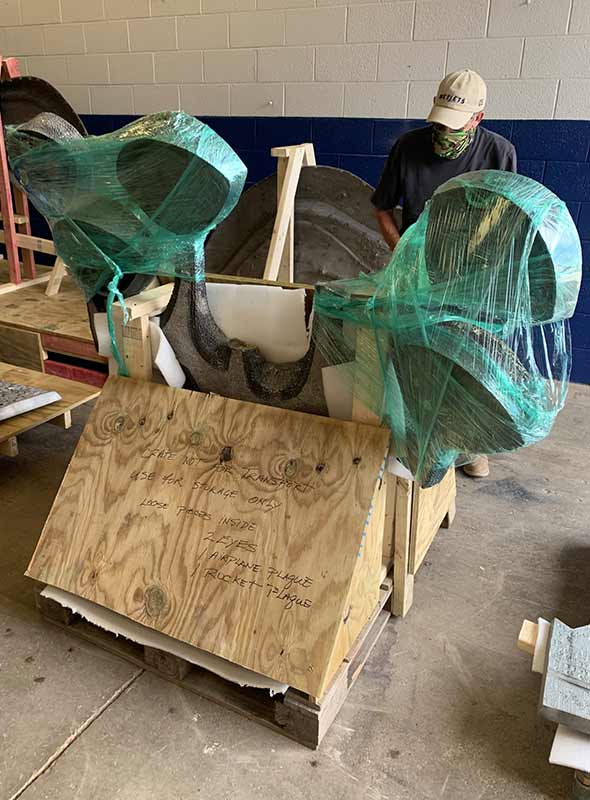
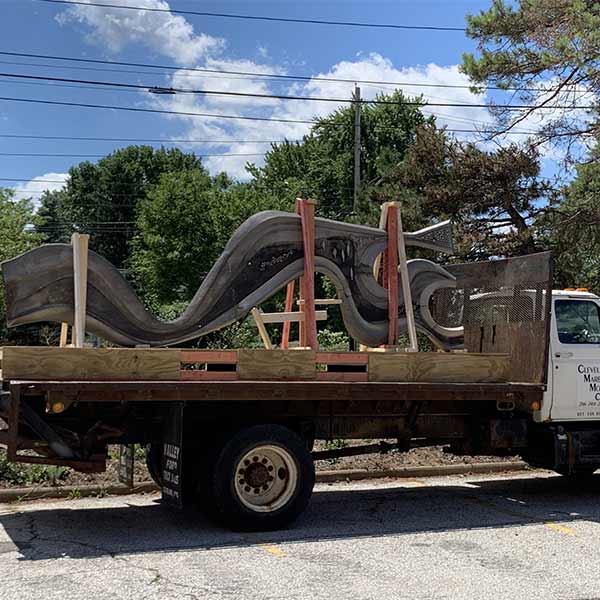
Under oversight of Fine Art Architectural staff, each element was further padded, pallet-wrapped and further enclosed with additional wood battens and plywood. The pallets were loaded onto a flat-bed truck by crane and secured with ratchet strapping. Fine Art Architectural Restoration staff accompanied the sculptural elements to the Berea school district storage facility and oversaw their transfer into a secured, climate controlled garage.
Fine Art Architectural Restoration staff drafted the restoration plan and selected a reputable Cleveland-area specialty surface finish company to do the extensive treatment. The restoration treatment was conducted utilizing a team of Berea-Midland students. The students were polled to choose the new location for the sculpture. They chose to install it next to the entrance of a new performing arts building.
Fine Art Architectural Restoration staff is experienced with oversight, consulting, installation, deinstallation, packing and movement of large objects, monuments and sculpture. Our staff has been involved with handling, movement and installation of extremely heavy and complex objects by major architects and artists. From large bronze sculpture to wood and plaster structures, to painted aluminum and stone fountains, our staff can design a custom plan to move nearly any art object or architectural element. Fine Art Architectural Restoration works with riggers, engineers, construction companies, stone masons and institutional facilities and groundskeeping staff to provide the safest and most innovative services in moving large-scale, historic or high value artifacts and architectural elements.