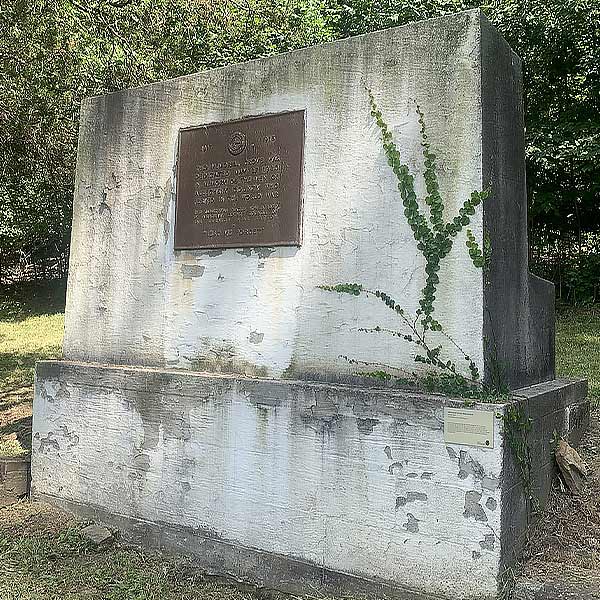
WWI Memorial Grove
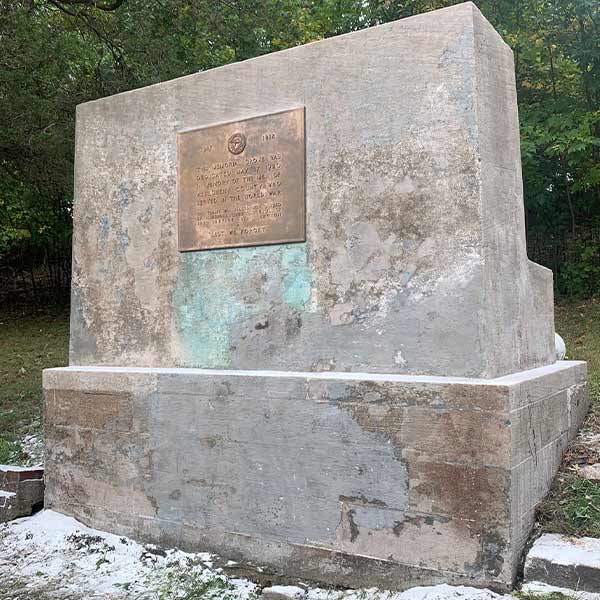
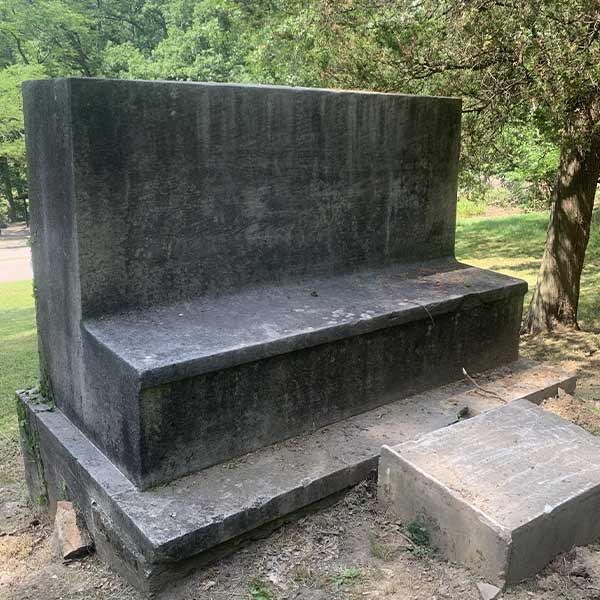
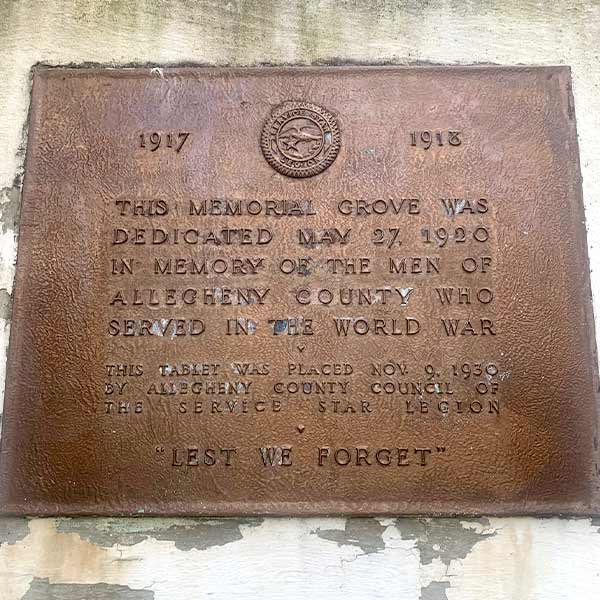
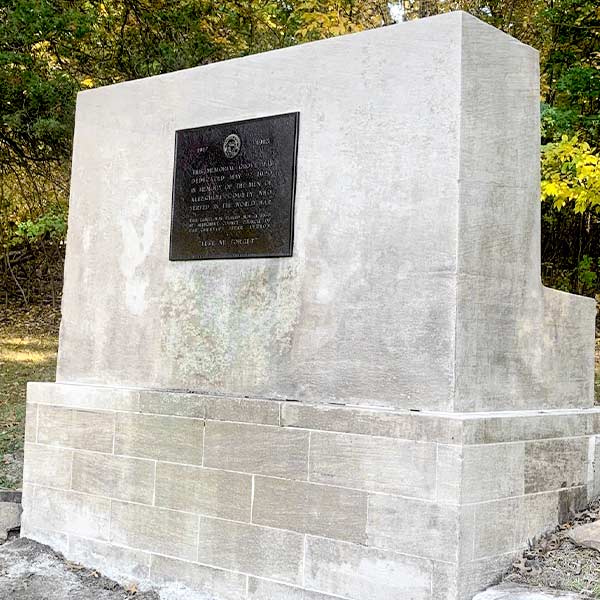
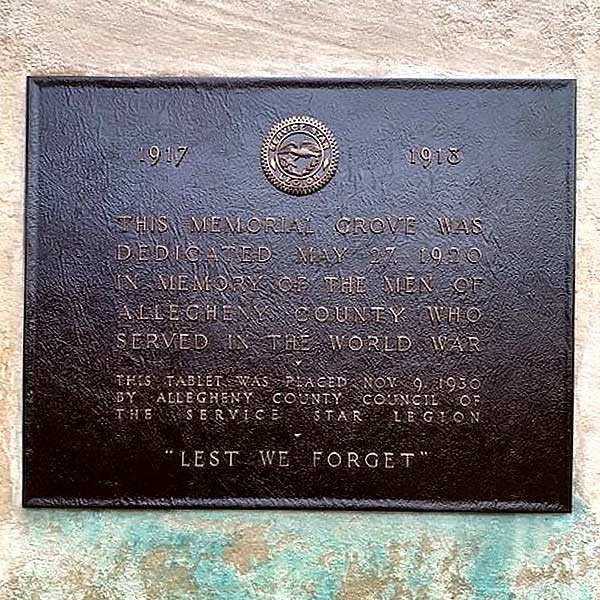
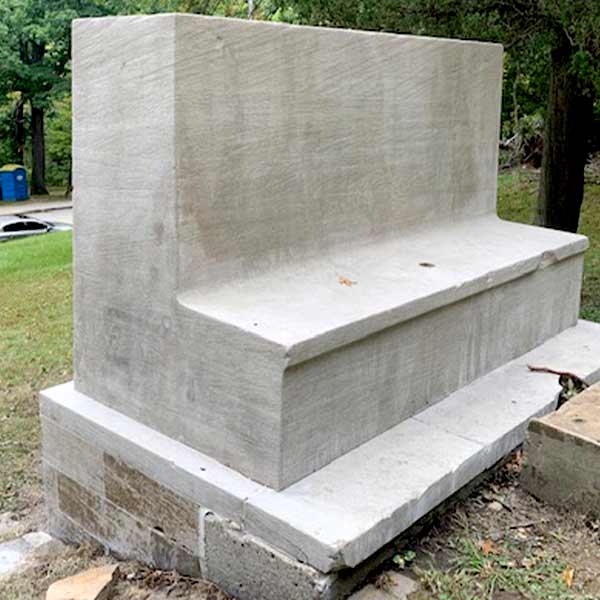
This memorial grove and variegated limestone stone monument were dedicated on May 27, 1920, in memory of the men of Allegheny County who served in World War I. The bronze tablet was placed Nov. 9, 1930, by Allegheny County Council of the Service Star Legion and reads: "Lest We Forget".
The United States entered the First World War in 1917 and was involved in the conflict for less than two years. During this time, upwards of 60,000 men of Allegheny County served in the Armed Forces. This grove of trees was dedicated to the men, living and dead, who served as veterans in that war, with the tablet being added a decade later.
Oak trees were dedicated to individual soldiers by their families, and planted on the hillside above the monument. At the base of each of the original oak trees is a concrete and metal marker inscribed with the soldier’s name. After 1920, the grove was more filled with trees. Over time many of the huge trees succumbed to disease, so the grove now appears sparser.
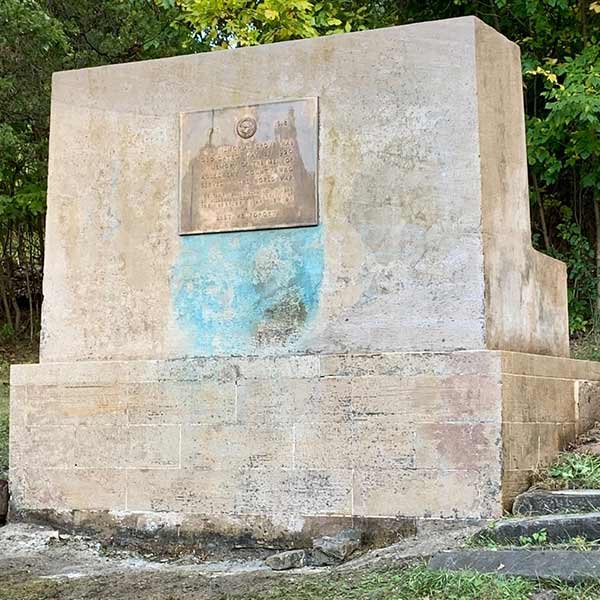
The Memorial Grove monument was extremely degraded and heavily restored. It will remain one of the most horribly over-cleaned objects ever encountered by this firm. Before treatment, the front of the stone marker was completely covered with a thick layer of white industrial paint. The paint was stained, cracking and flaking, and under the lifting flakes, a thick layer of continuous gray industrial primer was visible. The plaque was overcoated with several coats of bronze paint, which was darkened and stained and gave the plaque a monochromatic look. Originally the raised lettering would have been highlighted with raw bronze.
The white industrial paint was removed with gelled paint strippers and pressure washers. We noticed during this process that a sand-like aggregate had been mixed into the paint. The paint removal revealed a thick, continuous gray industrial primer layer. This layer could not be solubilized with paint stripping gels and needed to be mechanically removed with chisels and finishing hammers. The removal of the primer layer revealed a graffitied and patchy surface with a broad, intense green streak of copper corrosion product running down below the plaque. The stain had a blueish cast to it, suggesting that the front of the monument had been cleaned with muriatic acid, likely in an attempt to remove the graffiti and reduce the green stain, but made it worse.
The green stain was reduced with a commercial-grade copper stain-removing gel, which was then rinsed from the surface with a pressure washer. This lightened the stain significantly, but after a few days, it would start to return: a common issue with copper stains. It appeared the stain was embedded in an old restoration coating that penetrated the first few millimeters of the stone. To further reduce the stain, the area was further pared down mechanically with chisels and finishing hammers. This successfully lightened the stain, but it was left somewhat visible. It is common for stubborn stains to continue to fade due to our treatment combined with exposure to the elements. The stone monument was cleaned, and pressure washed overall with masonry cleaner diluted with water. The surface of the stone was sealed overall with several coats of matte masonry sealer.
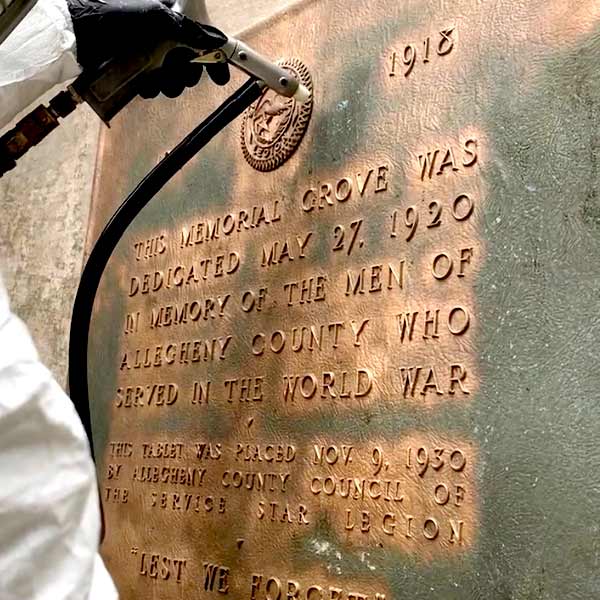
The plaque was blasted with glass beads to remove the thick layers of bronze paint. The brightened plaque was cleaned with solvent on cotton cloths, and then spray coated with several coats of brown lacquer. After spraying, the raised lettering and relief decorative motifs were cleared with a cloth covered block moistened with solvent. The plaque was then sprayed with several sealing coats of clear lacquer. The appearance of the monument is greatly improved. The plaque appears as it did when brand new, and the original, beautiful multi-tone limestone is now visible.
Fine Art Architectural Restoration prides itself on being among the most qualified in the country for plaque restoration. Our restoration methods were derived from years in the field and determined for ease and speed of work. All raised lettering on a bronze plaque has a limited life span. It is impractical to assume the lettering can be sanded each time a plaque is refinished. Eventually, you will run out of letter. Fine Art Architectural Restoration employs methods that do not remove metal, and speedily provide a bright metal surface on lettering, frames and rosette heads. Tinted and clear synthetic lacquers are applied by spray gun, and the lettering block-cleaned until it is bright. The synthetic lacquers employed are highly engineered for permanency and have been found to last a decade or more. We feel capable of restoring any cast plaque element or colored patina – no matter how unconventional – at any size. Fine Art Architectural Restoration can restore plaques on-site, at height and in remote locations.
All projects pictured are under the Pittsburgh City Office of Public Art and Civic Design.